Office of the Provost
First Year Focus: Supporting Students in Transition
Supporting Students in Transition
The magic of fall at UConn is upon us! From the idyllic New England college aesthetic of our campus, to tailgating at Rentschler field and pumpkin spice everything, being a Husky just feels a little extra special this time of year. But as the leaves begin to change, you may notice some changes in our students, too. Perhaps students who were once punctual and engaged now show up late or not at all. They might participate less or struggle to complete assignments on time. It can be easy to assume that students have lost interest or are being lazy, but the causal underpinnings of these behavior changes are usually a little more complex. For most first-year students, this is a particularly challenging time in their transition to college. As faculty and staff, how can we support our first-year students’ success as they move through this stage?
First, we must acknowledge where students are in their transition. A useful reference here is “the W curve”—a model initially published by Gullahorn and Gullahorn in 1963 to understand the process of culture shock and integration. Since its introduction to the field, higher education researchers have adapted the W-curve as model for the process of college student transition (Zellner and Mosier, 1993), (Berardo, 2012), (Schartner et al, 2015), (Zhao, 2025). While some argue that this model is not borne out by our best data for all students, e.g. (Chien, 2016) and (Dailey-Strand et al, 2021), it remains a helpful tool for identifying predictable phases that many students will experience in their first semester.
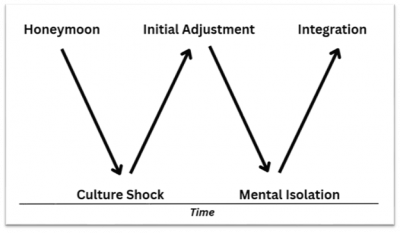
As students began the semester full of positive anticipation, they enjoyed the “honeymoon” phase, when everything felt new and exciting. However, as the novelty wears off and the reality of their new lifestyle settles in, they enter the “culture shock” phase. Around this time, many students (especially international students) will experience homesickness. The absence of familiar food, people, and routines places significant pressure on students’ brains and bodies to adapt, which can bring on symptoms of physical and mental illness.
Compounding these transitional challenges is the expectation to quickly form deep friendships. Many students believe they should have already found their “people,” and when reality doesn’t match this expectation, feelings of loneliness and isolation can emerge. A recent survey (Active Minds and Timely Care, 2024) found that nearly two-thirds of college students in the U.S. report feeling lonely, and those who do are four times more likely to experience severe psychological distress.
Academic stress adds yet another layer of complexity to this transitional period. As they adapt to the academic rigors of college, some students may fail an assignment or exam for the first time in their lives. This experience can trigger feelings of imposter syndrome and self-doubt.
Irregular sleep patterns, which are common among students (Lund et al, 2010) can exacerbate these issues. Poor sleep is widely understood to negatively affect overall well-being and recent work by Cresswell et al. (2023) also suggests that sleep quality can predict first-year students’ GPAs. Unsurprisingly, students who sleep less or have inconsistent sleep schedules tend to earn lower grades.
Though the phase of initial adjustment is on the horizon, many students are currently facing these overlapping physical, mental, social, emotional, and academic challenges. Here are a few ways we can support them within and beyond the classroom.
Notice and check in
- As a group: Before diving into content for the day, start each class by gauging how students are doing. A quick thumbs-up/thumbs-down/middle poll works well. Invite students to share briefly to acknowledge their experiences. This practice centers student well-being, shows care, and helps build trust which may make students more likely to approach you when personal challenges affect their academics.
- Individually: If you notice a student seems off, don’t hesitate to check in after class. Just knowing that someone on campus notices can have a positive impact. And for the students who you aren’t seeing in class? Send them an email every time they are absent- even if you do not get a response. Let them know you noticed their absence, hope they’re doing well, and offer support.
Find opportunities for flexibility
- Deadlines and academic standards matter. We should always hold our students to high expectations. However, flexibility doesn’t necessarily mean lowering expectations. Consider alternative ways students can engage or demonstrate learning. Can they choose different formats for assignments? Can they participate asynchronously? Offering options empowers students and helps them succeed by leveraging their strengths, especially during stressful times.
Normalize failure
- Every one of us has failed, probably multiple times in our lives. Over time, we come to see these experiences as learning opportunities and may even welcome failure as part of the process necessary for meaningful growth. Share your own experiences with failure, including the emotions that came with it, and how those moments contributed to your success. This helps students reframe their own setbacks and encourages resilience and experimentation instead of self-doubt.
Draw on faculty/staff networks
- If a student could benefit from campus resources, try going beyond suggesting they “visit office x”. Instead, see if you can make a personal connection for the student with a staff member in that office, or even walk them over. This can help students to actually access and engage the resources they need. If you have a first-year student in your class who is repeatedly absent, unresponsive, or who appears to be struggling with their transition, the First Year Experience office can help. You can make a referral using this form, and FYE staff office will draw on their connections across campus to reach and support the student. If you are concerned that a student may be a danger to themselves or others, be sure to complete a Care Team Referral.
As faculty and staff, we have a unique opportunity to support our students holistically. By noticing changes that arise in students’ transitions, checking in, offering flexibility, normalizing failure, and leveraging our campus networks, we can help students feel seen, supported, and empowered as they navigate their first semester in college.
References
Berardo, K. (2012). “Framework: Four Key Components of Transition Planning” in Building
Cultural Competence: Innovative Activities and Models, Deardorff, D.K. and Berardo, K. eds. New York Routledge.
Chien, Y.-Y. G. (2016). After six decades: Applying the U-curve hypothesis to the adjustment
of international postgraduate students. Journal of Research in International Education, 15(1).
Creswell JD, Tumminia MJ, Price S, Sefidgar Y, Cohen S, Ren Y, Brown J, Dey AK, Dutcher JM,
Villalba D, Mankoff J, Xu X, Creswell K, Doryab A, Mattingly S, Striegel A, Hachen D, Martinez G, Lovett MC. (2023) Nightly sleep duration predicts grade point average in the first year of college. Proc Natl Acad Sci,120(8).
Dailey-Strand, C., Collins, H. and Callaghan, D. (2021) ‘Those First Few Months Were
Horrible’: Cross-Cultural Adaptation and the J-Curve in the International Student Experience in the UK and Norway. Journal of Comparative & International Higher Education, 13(4).
Gullahorn, J. T., & Gullahorn, J. E. (1963). An extension of the U-curve hypothesis. Journal of
Social Issues, 19(3).
Lund H. G., Reider B. D., Whiting A. B., Prichard J. R. (2010) Sleep patterns and predictors of
disturbed sleep in a large population of college students. J. Adolesc. Health 46.
Schartner, Alina & Young, Tony. (2015). Culture shock or love at first sight? Exploring the
‘Honeymoon’ stage of the international student Sojourn. In Fabricius, A.H., Preisler, B. (eds) Transcultural Interaction and Linguistic Diversity in Higher Education. Palgrave Macmillan, London.
Zeller, W. J. and Mosier, R. (1993). Culture shock and the first-year experience. Journal of
College and University Student Housing, 23(2).
Zhao, X. (2025). Comparison of theoretical models of acculturation from the perspective of
educational psychology. World Journal of Educational Studies, 3(1).